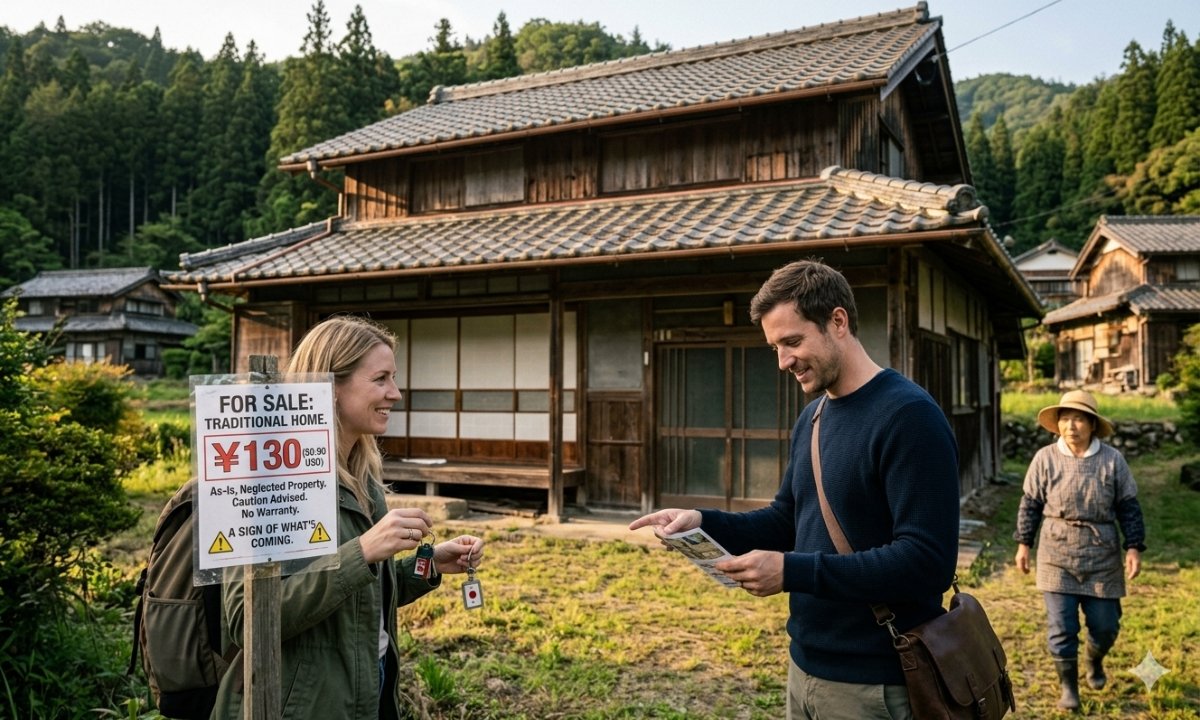
Japanese housing market is widely known to outsiders with its own peculiarities, but the latest buzz has taken the world by storm: brands for sales are the abandoned houses, known as akiya, that can sell at the price of merely 90 cents. What started as a strange idea with a opportunities massacre of budget travelers and digital nomads turns out to be raising alarm among economists and local authorities, as the new trend becomes a matter of concern. With the foreigners purchasing these cheap as dirt, properties in the rural setting, the experts believe that it is not just a bargain but rather a premonition of greater issues that may occur in one of the most developed economies of the world. As the population of Japan is dwindling and aging at a rate unparalleled in recent times, these fire-sale homes are an indication that there is a crisis that will trickle way past the borders of Japan.
The akiya process is the result of a century of rural emigration.
Youthful Japanese prefer to run to big cities such as Tokyo and Osaka to work and have fun and leave numerous deserted houses in their countryside such as in Nagano or in the Kyushu mountains. Local governments, which are in need of saving these dying villages, have thousands of homes posted online at fractions of a price, literally pennies, to entice new people to move in. They sell in large numbers to tourists, who are attracted by the pictures of inexpensive renovation and Instagram-deserving farm life. It is easy to navigate websites like Akiya Banks and Old Houses Japan, and accounts of Western customers repurposing decrepit houses into a home in the west take up social media. One of the American expatriates even wrote about purchasing of a classic minka farmhouse at less than half a thousand dollars with mountain range watch.
However, beneath the enticement, there is a stark reality.
This is because they are associated with headaches that cannot be cured by a single bargain price offered by these homes. A lot of akiya are well past their 40th anniversary, and their framework is deteriorated by rot, a shattered roof, and out-of-date circuitry that cannot withstand progressive security evaluations. Renovation charges may sky rocket in hundreds of thousands of dollars more so to foreigners struggling with Japanese stringent building regulations and seismic laws. Then there is isolation: the countryside has no good transportation, no fast internet or not even hospitals nearby. Reporting by the Ministry of Land, Infrastructure, Transport and Tourism of Japan in 2024 observed that more than 9 million homes out of all homes in the country (approximately 14 percent of total) are currently vacant and by 2030, the number would cross 12 million assuming that the trend remains the same.
Bigger Picture: A Population Time Bomb.
It is not only the case with empty houses, but it foreshadows the demographic crisis of Japan. In 2024 alone the country lost almost 600 000 people, and the birth rates were at the lowest level ever 1.2 children per woman. The National Institute of Population and Social Security Research predicts that by 2050 one out of every three Japanese will be 65 and above, straining the pensions system, medical care and the economy. Nomura research institute economists fear that the sales of akiya to tourists is concealing a hollowing out of rural Japan, where villages are disappearing. As one of the local mayors remarked in an interview, so those low-cost homes are an indicator of the future, which is a nation of ghosts.
This processes are further complicated by foreign buyers. Some implant and even begin to operate business, others consider properties as vacation flips exasperating the local frustrations. There has been an increase in tax on akiya owners, which discourages abandonment, but this is not properly enforced. Authorities have taken to warn that now they should be mindful, a combined warning issued in early 2026 by the tourism board and housing ministry of Japan revealed that inheriting any of these homes can be a trap, as oft times the family holds an attachment on the home, and natural calamities also pose a risk in Japan, it is a seismically active land.
The major dilemmas faced by Akiya Buyers.
To depict the challenges, we shall take the following snapshot of the universal akiya facts with reference to statistics of the Japanese real-estate associations:
| Challenge | Typical Cost (USD) | Frequency Among Listings |
|---|---|---|
| Renovation | $50,000–$200,000 | 85% of properties |
| Earthquake Proofing | $20,000–$100,000 | 70% required |
| Utilities Upgrade | $5,000–$15,000 | 90% needed |
| Legal Fees | $2,000–$10,000 | All foreign purchases |
This table demonstrates why most of the deals fail, as well as the buyers underestimating the amount of investment.
Nevertheless, there are success stories to people who plan well. To buy cheaply, smart buyers employ local akiya agents, form expatriate networks, and target the villages that offer subsidies such as free land or tax exemption. Places like Okayama Prefecture even offer grants to the tune of $20,000 to do renovations so long as you are willing to live there on a permanent basis. It is all about being realistic: being a tourist in Japan, it is not a getaway location but a long-term event.
The akiya boom in Japan acts as a call to all of the aging societies of the globe, whether in Italy or on the rural American countryside. It demonstrates why low prices may be the warning sign of systemic dangers that the international investor need not accept what can be read on the paper. What one economist wrote, it is true, a 90 little would purchase a house, but it will display a future to which we all may be subjected.
FAQs
Q1: Do akiya homes really not have liens?
No: in all cases employ counsel to inquire into debts or family claims, where there are 1 out of 5 cases thus.
Q2: Is buying and renovating hypothetically easy among foreigners?
Oh, but there are visas and permits; long-term residency is a gateway to subsidies.
Q3: Is this trend growing?
Listings increased 15 per cent. in 2025, but sales to residents are not keeping up with foreigners.