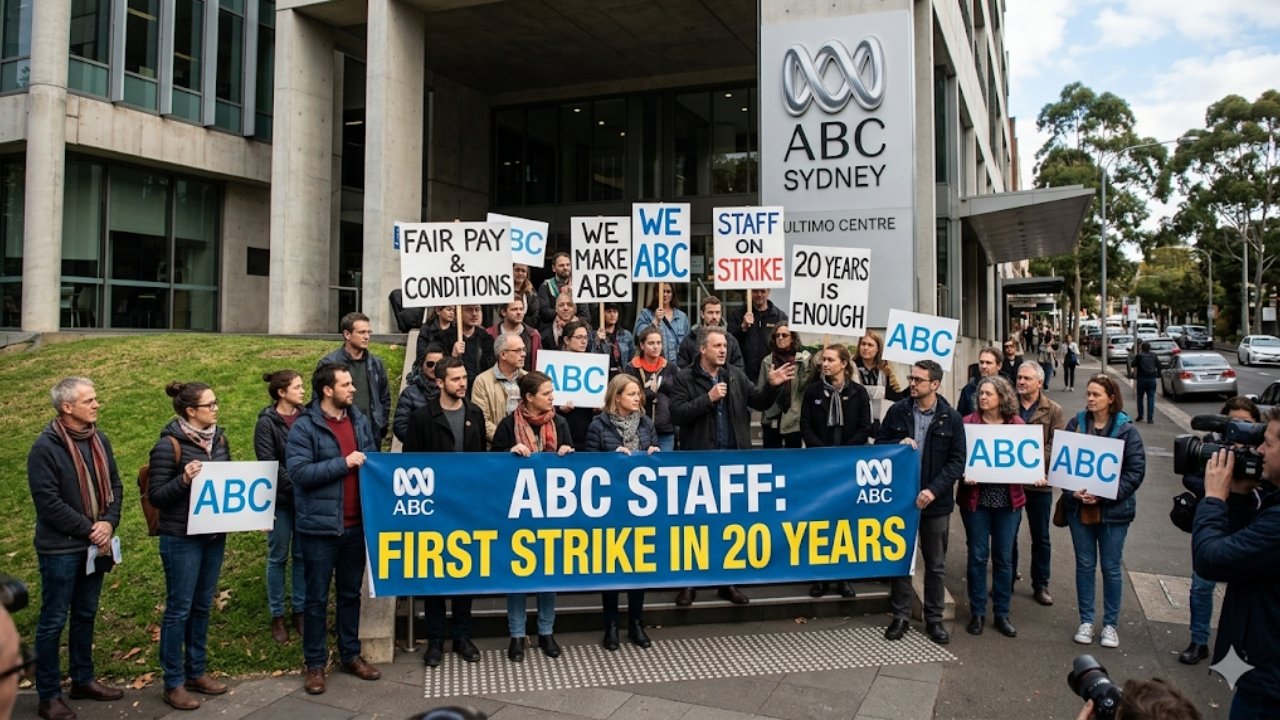
The employees at the Australian Broadcasting Corporation (ABC) are about to have their first large-scale strike in two decades, which is a risky move signifying severe exasperation about wages, employment protection and the way forward of community broadcasting. Thousands of journalists, producers, technicians and support staff at the newsrooms of ABC, ABC radio stations and television studios will go on strike on March 24, 2026, as the Media, Entertainment and Arts Alliance (MEAA) union declared the 24-hour walk out next week. This is done after several months of stalemated negotiations with the management. Employees did not accept a 2.5 percent increase in salary per year which was very low compared to inflation of approximately 4 percent. They further expressed their concern on outsourcing and uncompelled layoffs. To most, it comes as a final option after years of feeling underappreciated in an industry demolished by the digital blow up and budget reductions.
This strike is preceded by the general friction in the Australian media industry. The flagship state publicly funded national broadcaster, ABC, is the traditional source of independent journalism in the country. It offers both news immediately and investigations. However, governments have cut down its budget. The most recent federal allocation of 2026 27 will be 1.1 bn USD, a drop in real terms of a decade ago when the inflation-adjusted levels were high. This squeeze, according to the staff members, has resulted in understaffing. The vacancy levels on the major positions, including regional reporters, have increased by 15 per cent since 2023. Veteran ABC journalist, Elena Torres says it is time to stop using duct tape to cover up holes. She has been measuring 18 years in industrial dispute coverage at ABC News. Her experience introduces a workforce that is stretched to the limit now, demanding back collectively like never before since the 2006 walk-outs due to the same wage fights.
Why Now? Unpacking the Grievances
The gist of the conflict is an ideal storm of economic factors and restructuring. The payments available to the staff of ABC have decreased in real terms by a result of inflation by an estimated 8% over the last three years based on the data provided by Fair Work Commission, whereas the executive pay has increased at a higher rate. Employees are demanding an annual increase of 5.5 per cent (backdated) and assurances against additional sacking as ABC undergoes transformation to digital streaming and AI-friendly content provision to support its digital transformation. The management reasons that there is a lack of space to increase financially due to the tight federal budget which points to hiring tech employees in recent times as the sign of modernization. However, as union leaders such as MEAA Justin Hayes point out, this is a trend: 200 job cuts in 2025, alone, how many in their high-value news units, raising concerns about an emaciated public service.
It is not only about money but it is also about the soul of the public media. It is more than ever that the role of the ABC in the area of fact-checking and coverage of regional news is important due to the environment of fake news and polarization in the private media sector. Executives are anxious that reducing cost might lead to a loss of editorial freedom as similar scandals as the 2023 defunding threats by conservative politicians have in the past. Economists observe that most strikes can be the trigger to change; the 2006 action of the ABC is one that resulted in a 12 percent pay increase within three years following popular opposition.
Economic Ripple Effects and Starting Statistics.
This is because the timing of the strike occurred during a slumping economy where unemployment rates were at 4.8 (Australian Bureau of Statistics, March 2026), which may intensify the effect of the strike. ABC has a daily view of over 8.2 million, and therefore, stopping of its shows such as 7.30, News Breakfast, and radio messages may be devastating, more so in the rural regions that use its signal. The stakes are in a nutshell as follows:
| Metric | Current Figure | Staff Demand | Management Offer |
|---|---|---|---|
| Annual Pay Rise | N/A | 5.5% | 2.5% |
| Jobs Cut (2023-2026) | 450 | Zero further cuts | Capped at 100/year |
| Real Wage Erosion | 8% (past 3 years) | Full backpay | Partial adjustment |
| Daily Audience Reach | 8 million | Protected regional | Tech-focused shift |
The table can be used to show the gap in negotiations. The loss to productivity and ad-equivalent value to a used value of approaches to 2 million dollars therefore, potential cost to the productivity of the new advertisement is blackouts. The consumer confidence in the reliability of the media could be marred by the long term unfavorable atmosphere by the wider view of the economy by those at the reserve bank of Australia.
What Happens Next? Broader Implications
And in case the strike continues on April 1, anticipate rolling stoppages that extend to overtime restrictions that demand that the board at ABC go back to the table. The general sentiment in the market seems good; pre-polls by Ipsos indicate that 62 percent of the Australian population supported the workers by appreciating the ad-free requirement at ABC. Hope is provided by the precedents such as the 2024 strike by Qantas engineers, who finally received concessions after 48 hours. But threats be there: the government action through Fair Work may create binding arbitration, or they may cause the political temperature to ascend as a result of threats of funding.
To the ordinary Australian, this story raises the insecurity of societal institutions. An agreed agreement would stabilize ABC and increase its struggle with the world tech giants such as Google and Meta, who drain advertisements. Failure, though, could hasten the loss of talents to commercial competitors, which undermines the media ecosystem. This, according to labor experts, will trigger copycat behavior at SBS, as well as other government bodies, and is going to transform the industrial relations in 2026.
Ultimately, the ABC strike is an exercise that goes beyond a single work place, it is a vote on the importance of quality journalism during tough times. With the increased negotiation, the question on everybody is whether the year will be characterized by compromise or escalation.
FAQs
Q1: Will the strike impact on the online news of ABC?
Probably because, again, digital teams are involved and there will be delays in real-time updates and podcasts.
Q2: What is the comparison of this to former ABC strikes?
It is the inaugural full-day action since 2006, which was a four-hour affair that achieved improved remuneration.
Q3: Will the viewers be able to watch ABC material during the strike?
Video repeats and archives can continue, but live streams on both TV, Radio and applications will cease.